
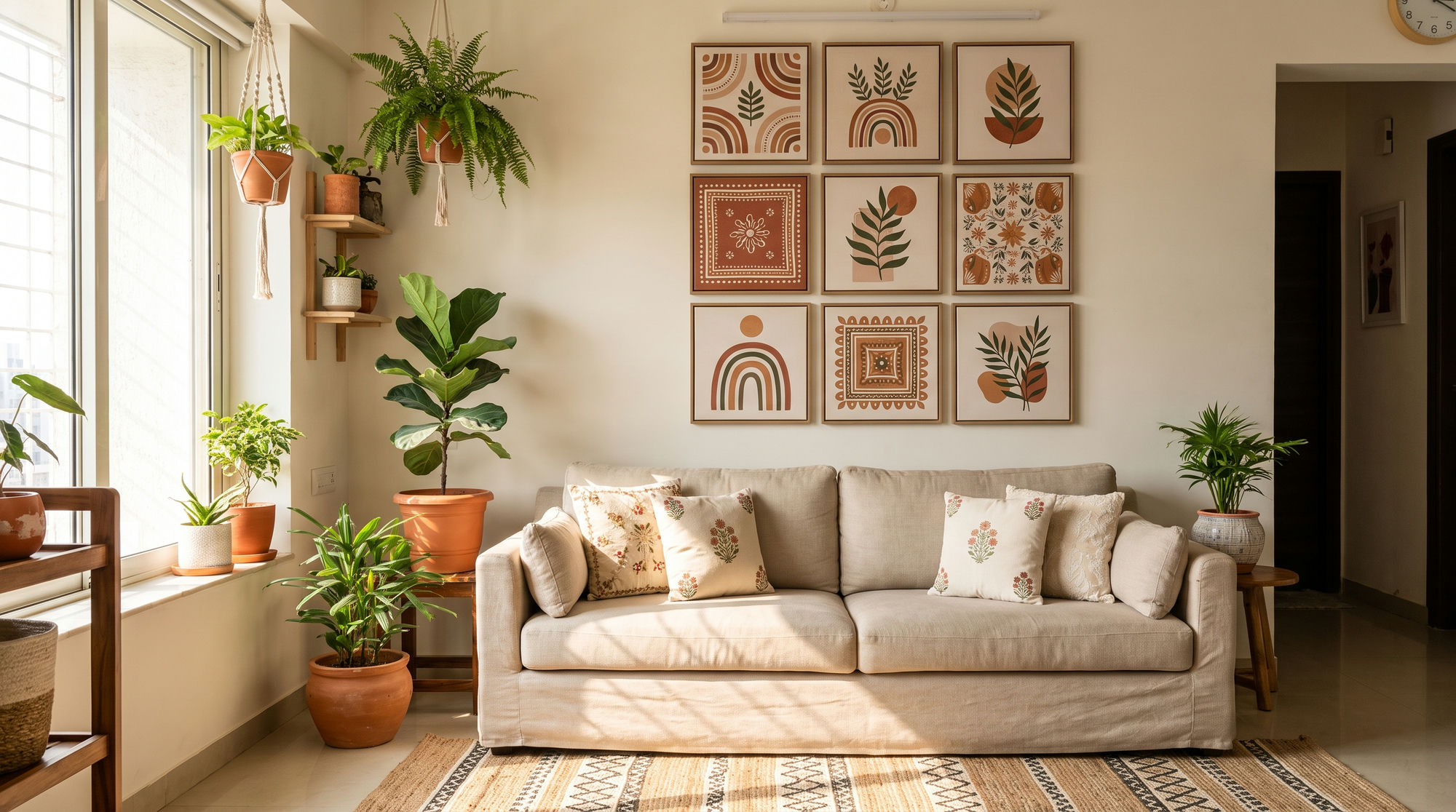
How to Create a Gallery Wall: 12 Layouts, Spacing Rules & Ideas for Indian Homes
By Prizt2026-10-028 min read
A gallery wall is the fastest way to make a blank wall look designed. Here are 12 layouts, the spacing and height rules that hold them together, and how to plan one without drilling a single hole.
A gallery wall is simply a group of artworks hung together so they read as one piece of wall decoration. It is the highest-impact way to fill a blank wall because it turns empty space into a focal point — no repainting, no new furniture, no renovation.
The catch is that a group of frames is much harder to balance than one large canvas. Get the spacing, height and mix of sizes right and the wall looks deliberate. Get them wrong and it looks like a pile of pictures. This guide covers both: the rules that always work, twelve layouts to copy, and how to plan the whole thing before you touch a drill.
01 The golden rules: spacing, height and planning
Four habits separate a gallery wall that looks designed from one that looks accidental.
Spacing. Leave 2–3 inches (5–8 cm) between frames. Consistent gaps are what make a mixed group read as one piece; uneven gaps are the single most common mistake. Keep the same gap whether the frames are large or small.
Height. Centre the whole group at roughly 57 inches (about 145 cm) from the floor — standard eye level. If the wall sits above furniture, the bottom edge should be 6–10 inches above the sofa back or headboard.
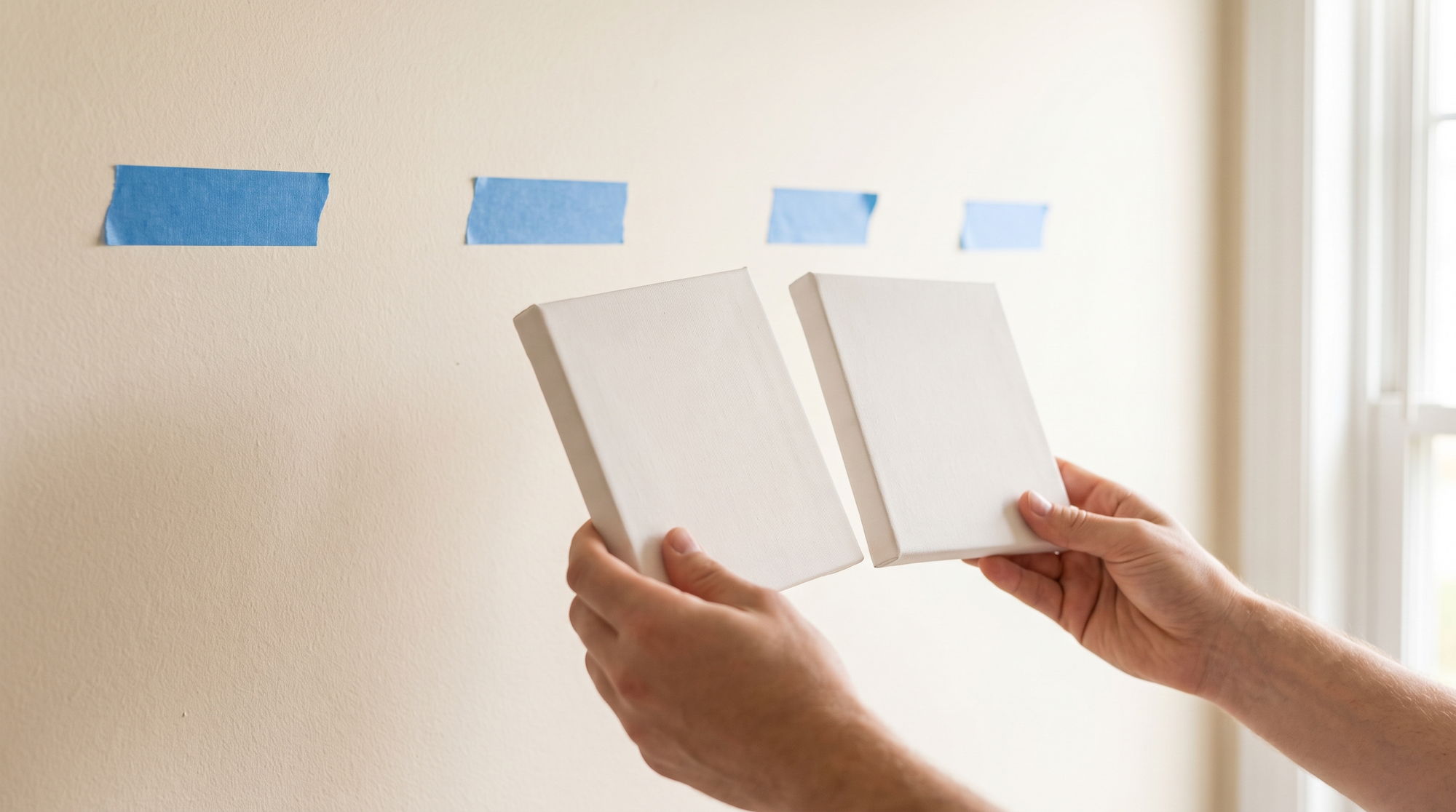
Plan on the floor first. Lay every piece out on the floor in front of the wall and shuffle until the composition feels balanced. It is far easier to move a frame across a rug than to fill a wrong hole.
Use paper templates. Trace each frame onto newspaper or kraft paper, cut the shapes out and tape them to the wall with painter’s tape. Live with the arrangement for a day, then hang along the tape lines and peel the paper away. For a full walkthrough, see our guide on how to hang canvas art.
02 The 12 best gallery wall layouts
- Grid — equal-size pieces in even rows and columns; a 3 × 3 of 12 × 18 or 18 × 24 prints is the most orderly classic.
- Salon-style (eclectic) — many different sizes packed edge to edge, the traditional European salon look; 8 × 12 up to 18 × 24.
- Staircase — pieces climbing in a diagonal that echoes the stair rail; 12 × 18 to 24 × 36, rising slightly in size as they go up.
- Symmetrical pairs — two matching prints flanking a central piece or a mirror; 18 × 24 or 24 × 36 on each side.
- Ledge shelves — stretched canvases leaned on a picture ledge so you can rearrange any time; 8 × 12 to 18 × 24.
- Hallway runner — a single row or a tight two-high grid that follows a corridor; 12 × 18 and 18 × 24.
- Above-sofa statement — one large anchor or a trio spanning two-thirds of the sofa; 36 × 48 or 48 × 66.
- Bedroom calm — a soft cluster or a single large piece centred above the bed; 18 × 24 to 24 × 36.
- Kids room mix — small, playful prints hung lower so children can enjoy them; 8 × 12 to 12 × 18.
- Monochrome theme — one colour family across varied subjects for a calm, curated look; 12 × 18 to 24 × 36.
- Oversized anchor plus satellites — one big hero canvas with smaller pieces around it; anchor 24 × 36 or 36 × 48, satellites 8 × 12 or 12 × 18.
- Corner wrap — art that turns a 90-degree corner so two walls read as one continuous gallery; 12 × 18 to 24 × 36.
03 Salon-style and eclectic walls
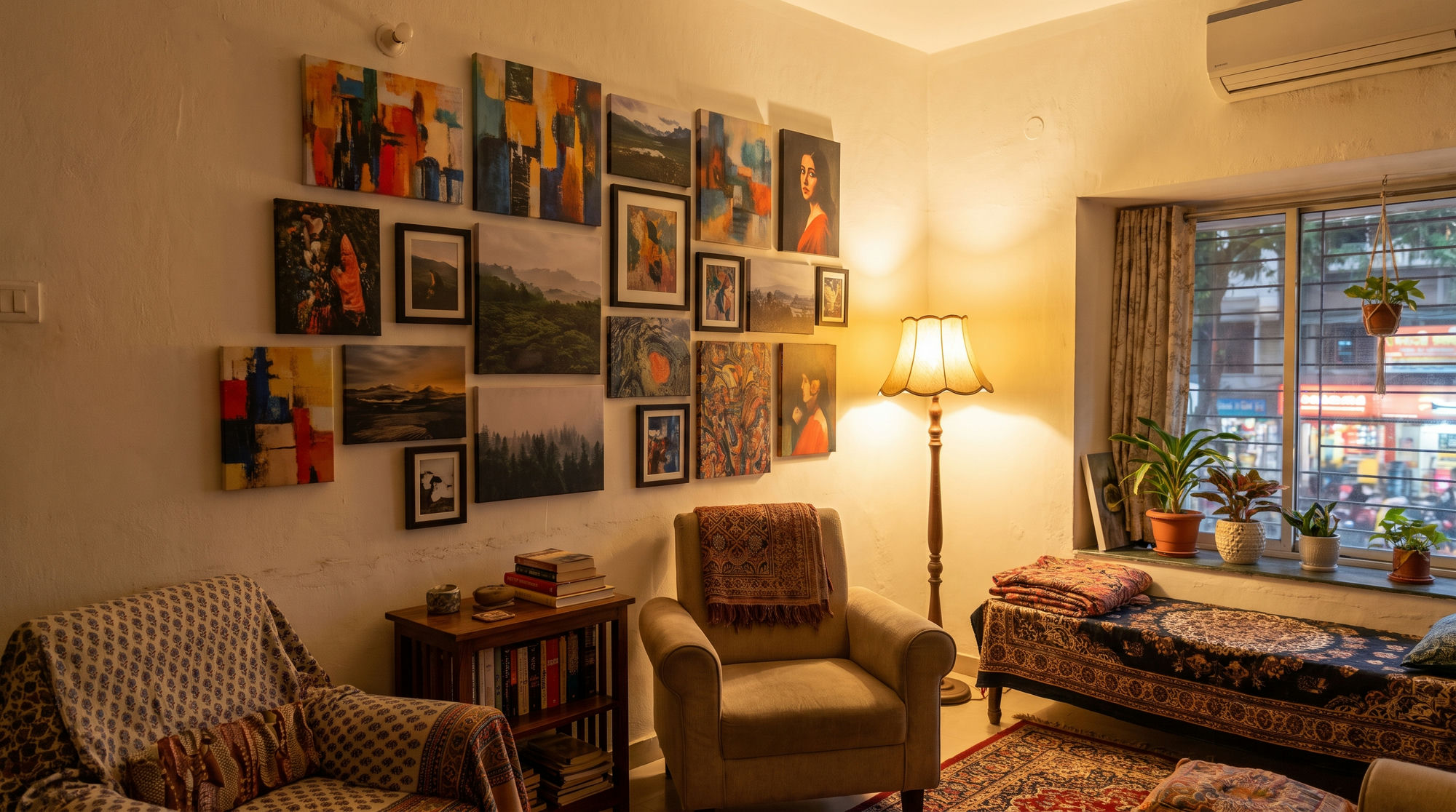
Salon-style is the oldest and most forgiving gallery wall there is. Instead of a tidy grid, you fill the wall almost edge to edge with different sizes and shapes, so the eye reads texture and colour rather than individual frames. Because nothing is perfectly aligned, a new piece can be added any time without re-hanging the whole wall.
The trick is to keep the gaps consistent (2–3 inches) and to repeat two or three colour families across the mix. Start with your largest piece slightly off-centre, then build outwards with medium and small canvases until the group feels balanced, leaving a little air between pieces rather than packing them like a jigsaw.
For a modern Indian home, a warm palette makes this style feel intentional rather than busy. Mix a colourful botanical pair with an abstract beach canvas and a neutral minimalist abstract landscape — 12 × 18 and 18 × 24 sizes give you enough variety to fill a wide wall.
04 Staircase gallery walls
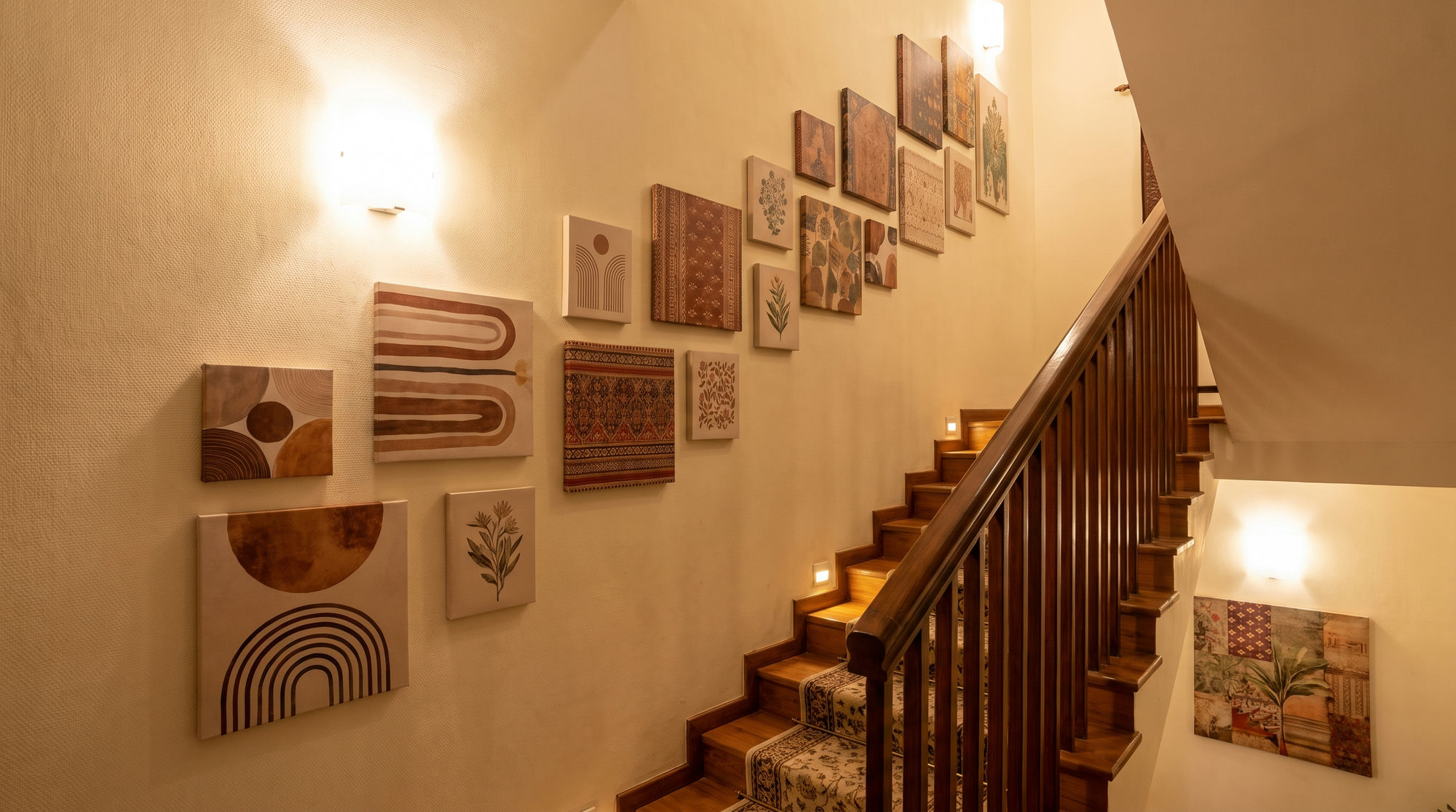
Staircases are the one place where a diagonal layout wins. Hang the pieces so the group rises with the stairs — the bottom of the group roughly parallel to the handrail — and the wall feels connected to the architecture instead of floating above it.
Two practical rules. First, centre the art on the wall between the rail and the ceiling, not on the steps, and measure each piece from the stair tread directly below it so the diagonal stays even. Second, resist the temptation to use only small frames: stairs look best when the pieces grow slightly in size as they rise, ending with a 24 × 36 or 30 × 40 at the top.
An odd number — three, five or seven pieces — reads more naturally than an even one on a slope. Botanicals, landscapes and abstract sets all work; keep the palette calm so the wall does not compete with the stairs themselves. If you are starting on a staircase, a boho geometric arches set is an easy, cohesive choice.
05 Gallery walls for the bedroom
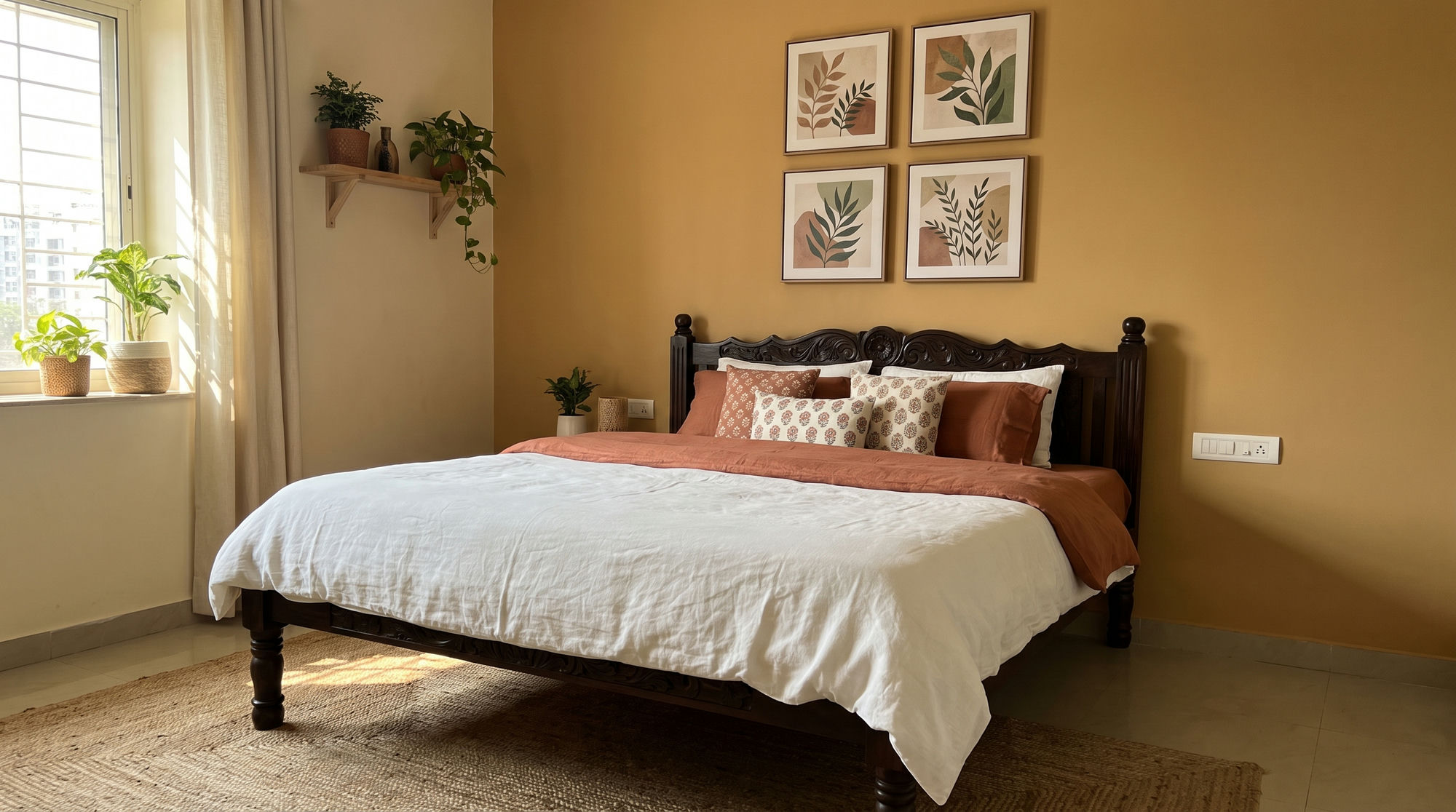
Above the bed, less is more. A gallery wall in a bedroom should feel restful, so favour soft abstracts, gentle botanicals and muted landscapes over loud, high-contrast pieces.
Centre the group on the bed and let the full spread span about two-thirds of the bed width. Leave 6–10 inches between the top of the headboard and the bottom of the lowest frame — the same clearance as a single piece — and keep the gaps between frames to 2–3 inches. A symmetrical pair above two bedside tables is the calmest option; a loose cluster of four to six small pieces suits a wider wall.
Stick to two or three colours drawn from your bedding. A muted minimalist abstract landscape or a soft golden nebula abstract keeps the room settled, and canvas has no glass to catch the light while you sleep.
06 Choosing art that hangs together
Choose a palette, not a theme. The most reliable gallery walls share colour rather than subject. Pick two or three colours — say rust, cream and sage — and let any subject in those tones join the group. A shared palette is what makes a mixed wall look curated.
Mix sizes, but keep one anchor. Start with one large piece that sets the scale, then surround it with smaller ones. Odd numbers (three, five, seven) balance more naturally than even, and the anchor should sit slightly off-centre so the group does not feel static.
Repeat one element. A consistent frame colour, a shared inch of white border, or one repeated motif ties everything together. If you are beginning from scratch, pick three pieces — one large statement canvas, one Kandinsky-style line art and one mid-century rainbow — and you have an anchor and two satellites in a single order.
07 Hanging a gallery wall without damage
- Adhesive hooks rated for the weight — canvas is light for its size, so a medium print usually holds on a smooth painted wall.
- Command-style strips for small and medium prints; press for the full recommended time before hanging.
- A picture ledge or shelf — lean canvases instead of hanging them, and rearrange whenever you like.
- Lean on a sideboard or console, propped against the wall, for an instant no-drill display.
- For large pieces, or on textured or gypsum walls, use one proper wall anchor — and a hollow-wall anchor on plasterboard.
- Avoid adhesive hooks above a radiator, in direct sun, or on freshly painted walls.
08 The B2G1 angle: build a gallery wall for less
A gallery wall needs between three and nine pieces, which is exactly the range where Prizt’s Diwali offer does the most work. Buy 2, get the 3rd free — in every group of three canvases, the cheapest piece is free. Order six and you pay for four; order nine and you pay for six. At ₹699 a canvas, buying in threes brings the effective price to roughly ₹466 a piece, so a five- or six-piece wall costs far less than it would piece by piece.
The offer runs to 10 November 2026. Shipping is free across India, cash on delivery is available, and every order is covered by a 30-day return window — useful when you are hanging a group and want to see it in the room first.
Not sure where to start? Build around one hero canvas and add smaller pieces from the same palette. Browse living room canvas art for anchors and companion prints, or mix in a smiling sun or cottagecore rabbit for a kids’ wall. Add any three to your cart and the discount is applied automatically at checkout.
09 Frequently asked questions
Leave 2–3 inches (5–8 cm) between frames, and keep that gap identical throughout the group. Consistent spacing is what makes mixed sizes read as one composition; uneven gaps are what make a gallery wall look accidental.
Start with a piece you love
Every Prizt canvas is printed on premium canvas in India and arrives in protective 4-layer packaging — so what lands on your wall is exactly what you picked.
Keep reading
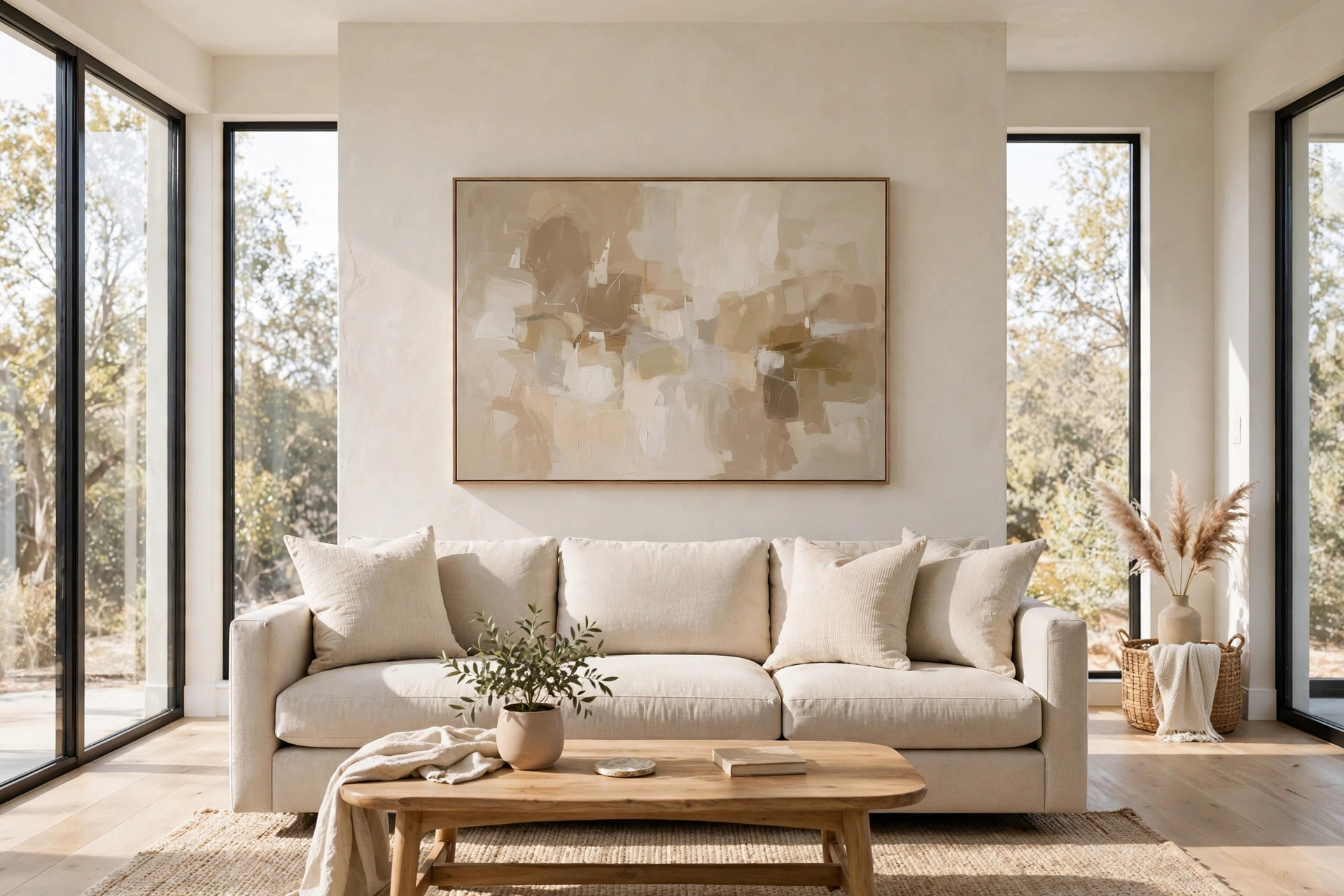
Canvas Print Size Guide: Choosing the Right Size for Every Room
Not sure which canvas size fits your wall? Here is how to match our 8 canvas sizes to the room, wall, and look you want.
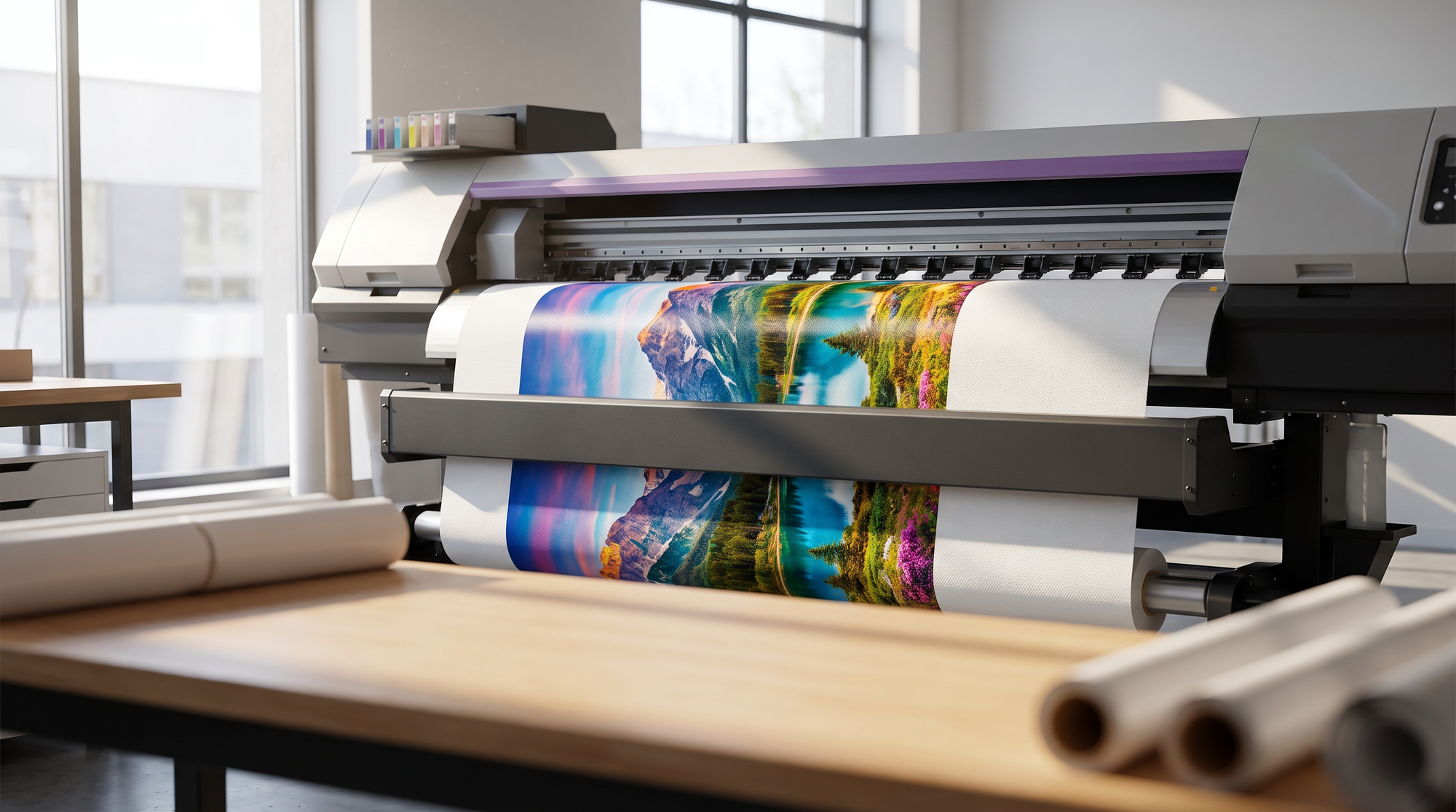
What Is Eco-Solvent Canvas Printing? Why Premium Canvas Beats Posters & Flex
Eco-Solvent printing uses low-VOC inks on real canvas for rich, durable, gallery-quality art. Here is why it beats posters, flex, and paper prints.
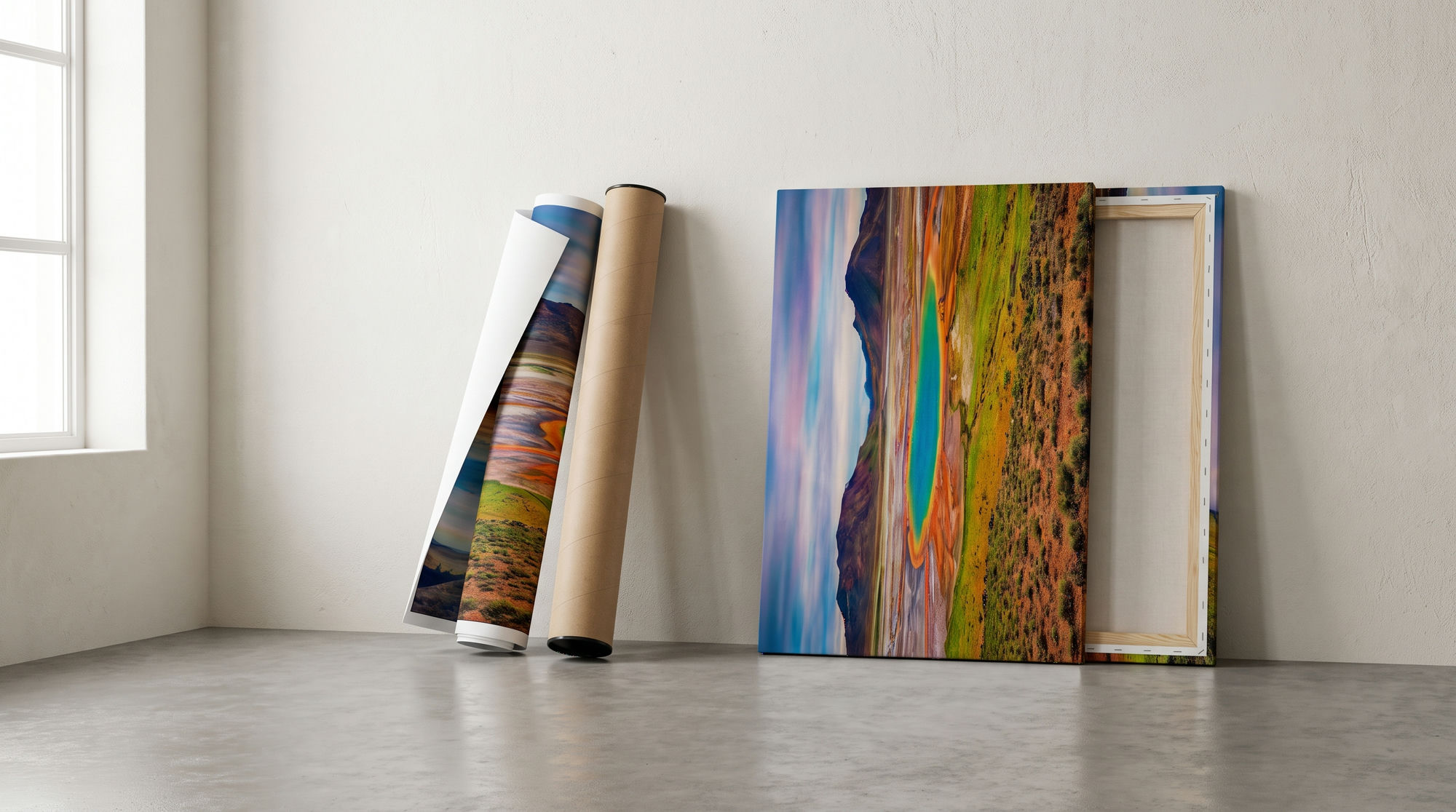
Rolled vs Stretched Canvas: Which Should You Choose?
Rolled ships flat for local framing; Stretched arrives ready to hang on a quality frame. Here is how to decide.
Printed on premium canvas, made in India. Browse the collection